Built for Joshua Tree desert STR owners

Joshua Tree cost segregation,
by the actual numbers.

Joshua Tree, Yucca Valley, Pioneertown, 29 Palms, Morongo Basin — most desert STR owners save $30K–$80K in Year-1 federal tax. California decouples from §168(k) bonus depreciation, so CA state savings are smaller upfront but accrue over the recovery period. The bigger story: Joshua Tree's design-destination STR market drives the highest FF&E density per dollar of basis we measure ($40K–$80K per property), more than offsetting the CA state-side complexity. 30-second estimate, no signup.

✓ 60-day money-back guarantee ✓ Engineer sign-off ✓ IRS ATG aligned

Reviewed by Cost Seg Smart Editorial Team · Last reviewed: · Methodology: IRS Pub. 5653, Rev. Proc. 87-56, what is cost segregation?

Estimate (live) Updates as you type
$525K

Over $3M? Email us for a custom quote.

Property type
Estimated Year-1 federal savings
$0
on $0 of accelerated deductions
+ ~$0 CA state Year-1 (decoupled — see note)
CA state benefit accrues over Years 1-15 instead of upfront. How the CA math works →
Get the full study at costsegsmart.com → starting at $495

Estimate is illustrative. Final number is engineered to your specific property and reviewed by a licensed engineer.

$38,200
Median Year-1 federal savings for Joshua Tree owners over $400K basis (100% bonus, 37% bracket, illustrative).
< 1 hr
Typical study turnaround at Cost Seg Smart.
$495
Studies start at $495 for sub-$300K properties. Most Joshua Tree STRs land in the $795 tier.

If your Joshua Tree property is over $200K basis and held for 12+ months, you can run the full study at costsegsmart.com — typically delivered in under an hour, starting at $495. Order at Cost Seg Smart →

Why Joshua Tree is different

Five local factors define Joshua Tree cost-seg math.

Joshua Tree is structurally unique among US STR markets — a pure-STR economy anchored on a national park, with design-destination architecture that drives premium FF&E and CA tax complexity to manage.

Pure STR economy — no LTR or commercial alternative

Joshua Tree's investor market is ~95% short-term rental. No meaningful long-term rental market (too few year-round residents), almost no commercial real estate, no condo developments at scale. This means the cost-seg analysis is straightforward: every property is sized for STR, FF&E density is high, accelerated reclassification runs 27-30%. Less analysis complexity, more upside per dollar invested.

Joshua Tree National Park anchor — 3M+ visitors/year

JTNP draws 3+ million annual visitors with year-round demand peaks (winter Nov-Apr, spring wildflower March-May, summer evening hikes Jun-Sept, fall climbing Oct-Nov). Add Coachella spillover (April), Joshua Tree Music Festival (May), bachelorette/wedding tourism. Demand is structurally diversified across seasons — STR occupancy averages 60-75% across the year, well above national STR median.

Design-destination architecture — premium FF&E density

Joshua Tree guests pick properties by architectural style and aesthetic — mid-century modern desert, geodesic domes, off-grid bunkhouses, Spanish revival, architectural minimalist. To compete, owners stock premium FF&E: designer furniture, premium art, high-end kitchens, stargazing setups, hot tubs, designer linens. FF&E density typically runs $40K–$80K per property — the highest STR FF&E density we measure outside the Disney-corridor resort communities.

San Bernardino County STR cap — scarcity premium

San Bernardino County passed STR permit caps in 2021 (Joshua Tree town ~600 permits, Yucca Valley town ~250 permits, others have similar limits). Permits are transferable but limited. Operationally: if you already hold a permitted STR, scarcity drives appreciation. If you're entering the market, you typically acquire an existing permitted property at a premium. Cost-seg eligibility is unaffected — but the cap meaningfully shapes acquisition strategy and resale value.

California §168(k) decoupling — federal benefit still strong, state benefit stretched

CA does not allow federal bonus depreciation on the state side. Your federal Year-1 deduction is large; your CA Year-1 deduction is small (MACRS straight-line on reclassified portion). This is the most-cited "Joshua Tree gotcha" but it's overstated. Federal §168(k) is still 100% Year-1 deductible — that's where the real money is. CA's contribution stretches over 5/7/15 years but totals to comparable absolute savings over the holding period. Operational cost: parallel-schedule tracking handled by your CPA. Cost Seg Smart studies include both federal and CA-compatible schedules as standard.

What it actually looks like

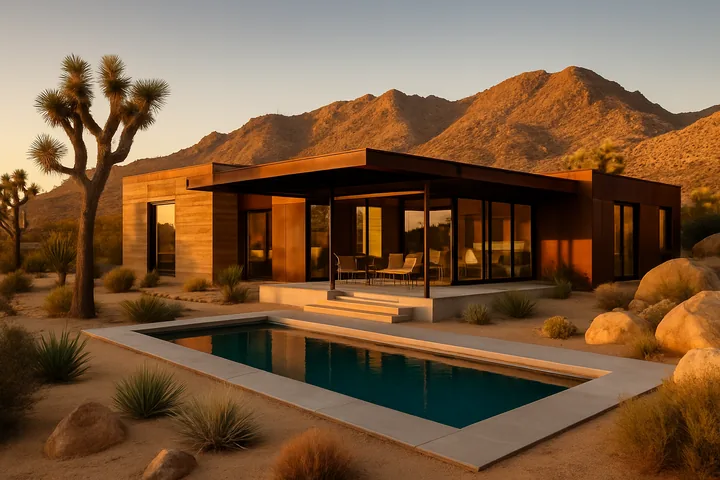
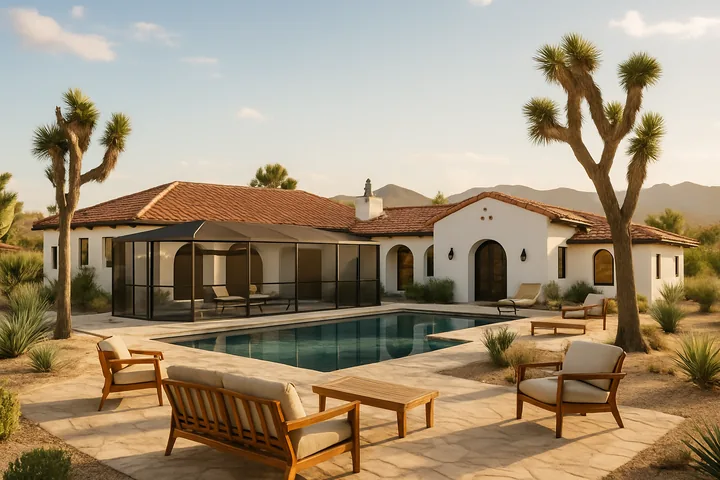
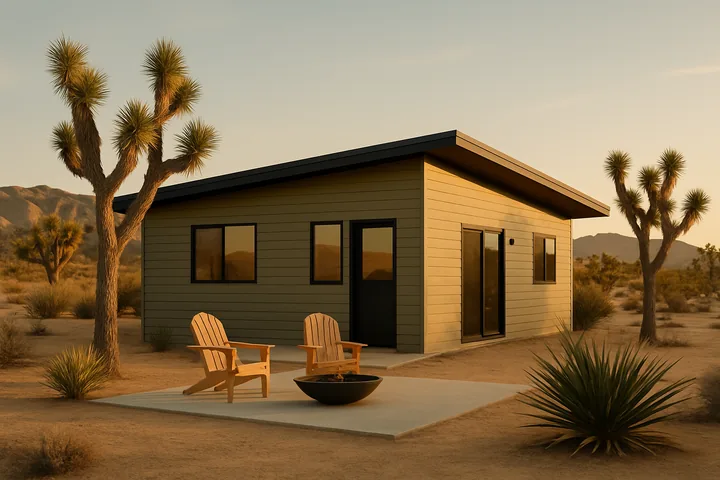
Three Joshua Tree properties — all STR.

Engine-truth outputs. 2025 placed-in-service, 100% bonus depreciation under OBBBA, 37% federal bracket. CA state benefit shown separately — accrues over 5/7/15 years.

These outputs come straight from our production engine. CA state savings accrue over the recovery period — see CA tax math section. To see a worked example as a full engineered PDF, browse a sample Joshua Tree report → at costsegsmart.com.

When the math doesn't work

Three situations where we'll tell you to skip it.

Joshua Tree's pure-STR market makes cost seg cleaner than diversified-property markets. Almost everything pencils — but there are real CA-specific edge cases.

Property under $200K basis

The $495 study still produces a net federal benefit, but CA decoupling complexity makes the all-in math marginal at small sizes — typically $2K–$4K Year-1 fed + minimal CA. Rare in Joshua Tree where most STRs clear $350K easily, but possible in Wonder Valley or remote Landers.

Selling within 12 months without a 1031 exchange

Federal depreciation recapture on sale will eat most of the Year-1 acceleration. CA recapture mechanics add complexity. Wait, do the 1031 (CA-to-CA stays clean), or hold longer.

CPA isn't equipped to handle CA parallel-schedule tracking

CA requires a separate state depreciation schedule per property, not just an addback. If your CPA isn't fluent in CA depreciation mechanics, cost seg adds tax-prep burden. Resolution: switch to a CA-experienced CPA, or add Cost Seg Smart's CPA Guidance addendum to the study (includes CA-compatible schedules).

Everything else — Joshua Tree town STRs, Pioneertown architectural rentals, Yucca Valley estates, Morongo Basin design destinations — pencils. The federal Year-1 deduction is the same as anywhere; CA contributes meaningfully over the holding period.

How we calculate Joshua Tree numbers

RSMeans 2024 + San Bernardino County Assessor + CA parallel schedules.

RSMeans 2024 cost data with Morongo Basin regional multipliers, San Bernardino County Assessor records for land allocation, the IRS Cost Segregation Audit Techniques Guide methodology for federal classification, AND CA Schedule CA D-1 (assets) parallel depreciation schedule for California compliance. Every Cost Seg Smart California study ships both federal and CA-compatible schedules as standard. An engineer reviews and signs off before delivery.

Full methodology details →
  • IRS ATG Aligned
    Mirrors Publication 5653
  • CA Parallel Schedules
    Schedule CA D-1 included as standard
  • Engineer Sign-Off
    Every study, no exceptions
  • 60-day money-back
    If your CPA can't use the report
Questions

Joshua Tree-specific things people ask.

California decouples from federal §168(k) — how does that affect my Joshua Tree cost seg?

Your federal Year-1 deduction is the same as anywhere — 100% bonus depreciation under OBBBA. The California state side is where it differs. CA does not allow §168(k) bonus depreciation; instead, the reclassified property depreciates under normal MACRS straight-line on the CA Schedule CA D-1 (assets) parallel schedule. The federal §168(k) deduction is added back on your CA return, then state depreciation accrues over the recovery period. Net Year-1 effect: federal benefit ~$30K–$80K (large); CA benefit ~$1.5K–$5K (small first year, accruing more over Years 2-15). Combined Year-1 marginal: ~38-42% depending on bracket.

Does the San Bernardino County STR cap affect my cost segregation?

Operationally yes (it limits new STR permits in Joshua Tree town and adjacent areas to a hard cap). For cost segregation, no — your federal basis is your basis regardless of permit availability. If you already hold a permitted STR, the cap is favorable for property value (scarcity drives appreciation). If you're trying to enter the market, the cap means you typically acquire an existing permitted property at a premium. Cost seg eligibility is unaffected.

Why does Joshua Tree have such high STR FF&E density compared to other markets?

Joshua Tree is a 'design destination' STR market — guests pick by architectural style and aesthetic (mid-century modern, off-grid bunkhouses, geodesic domes, Spanish revival, architectural minimalist). Owners stock premium FF&E: designer furniture, premium art, kitchens with high-end appliances, outdoor stargazing setups, hot tubs, designer linens. FF&E typically runs $40K–$80K per property — well above national STR median. All 5-year personal property under MACRS bonus depreciation.

Can I cost seg a property I'm converting from primary residence to STR?

Yes, on the rental portion only. Conversion date establishes the basis — typically the lower of original cost basis or fair market value at conversion. If you're converting the entire property, full basis applies. If you're keeping part as primary residence (e.g., a casita STR while you live in the main house), an engineer scopes the rental-portion basis allocation. Common pattern in Joshua Tree where weekenders convert their second-home property to year-round STR.

How does Joshua Tree compare to Palm Springs or Phoenix?

Joshua Tree is more affordable to enter ($300K-$700K vs $700K-$2M+ in Palm Springs) and has higher STR yield per dollar of investment. Cost-seg math is similar to Palm Springs (both CA, both face §168(k) decoupling). Compared to Phoenix: less total state-side benefit (CA's parallel-schedule complexity vs AZ's clean §168(k) conformity), but Joshua Tree's lower entry price means higher cost-seg ROI per dollar invested. Both have ~27-29% reclassification on STR.

I'm doing a 1031 exchange — what's the cleanest move?

CA-to-CA 1031s are simplest — your parallel CA schedule continues on the new property. CA-to-out-of-state: CA tracking continues on the relinquished CA basis until eventual disposition; new (non-CA) property gets clean §168(k) federal treatment. Out-of-state-to-Joshua-Tree: fresh CA tracking starts on the new property. Your CPA handles the parallel-schedule mechanics — typical to lean on a CPA who specifically knows California depreciation rules.
Have a question we didn't cover? Email [email protected] or see the full FAQ at Cost Seg Smart →

Ready to see your number?

Order your Joshua Tree study —
under 1 hour, starting at $495.

Joshua Tree, Yucca Valley, Pioneertown, 29 Palms, Landers, Wonder Valley desert STR — we generate the engineered PDF with both federal and California-compatible depreciation schedules, an engineer signs off, your CPA files. Studies start at $495; most Joshua Tree properties land in the $795 tier.

60-day money-back guarantee · CPA-Ready · Engineer signs every study · CA parallel schedules included